
The Midterm Massacre: Why Wall Street's Election-Eve Selloff Is Bad News
Wall Street walked into Election Day bleeding. In the final trading sessions before Americans voted on control of Congress, the technology stocks that carried this bull market cracked, and the damage has traders calling it the "Midterm Massacre."
The Nasdaq Composite lost 5% in October, capped by a 2.9% plunge on Friday, October 30 — its worst session in nearly four months. On Monday, the Nasdaq 100 fell another 1.4%, officially entering correction territory, 10% below its October peak. The S&P 500 slipped 0.5% and has broken below long-term technical support.
Election Day itself opened with a fragile, mixed bounce rather than relief. Dow futures pointed lower before the bell, Apple sank nearly 4% in premarket trading, and early gains in the Nasdaq were small enough to vanish by the closing bell. The selloff has paused, not reversed.
What lit the fuse
The slide began with earnings, not ballots. Disappointing results from Alphabet, Amazon and Intel sparked Friday’s rout, reviving doubts about how fast the AI spending boom can turn into profit.
The bad news kept coming. Apple issued a disappointing margin forecast and missed on iPad sales and Greater China revenue. Palantir fell even after beating expectations, and Shopify joined the losers before Tuesday’s open. Advanced Micro Devices reports after the close tonight, putting one more AI bellwether on the same calendar as the vote count.
Geopolitics added noise. Oil prices dropped Monday on signs of progress toward peace talks with Iran, dragging energy shares down alongside tech. Monday’s early tech rebound faded into a late-day selloff — a classic sign of sellers using rallies to get out.
The ballot box on top
The election turned an earnings wobble into something sharper. Betting markets give Democrats roughly a 94% chance of winning the House and about a 71% chance of taking both chambers. JPMorgan puts a Democratic sweep at 66%.
The prevailing view on Wall Street is that a sweep would be the least friendly result for the AI trade. Investors fear a Democratic Congress could pursue tighter regulation of data centers and big tech — the very industry that has driven most of the market’s gains for nearly four years. JPMorgan’s models show the S&P 500 moving anywhere from down 0.25% to up 0.5% under a sweep, versus gains of 1% or more if Republicans hold Congress.
The risk reaches beyond tech. Strategists are watching whether the results change expectations for federal spending, borrowing and the administration’s ability to advance its agenda. That puts the dollar, Treasury yields and policy-sensitive sectors squarely in play when results land tonight.
Why an election-eve crash is bad news
A selloff timed to the vote is more than a bad week. It does damage that outlasts the results.
It hits households before they vote. Most Americans’ retirement savings sit in index funds dominated by the same tech giants now falling. A 401(k) statement showing October losses lands in the mailbox just as voters judge the economy — and the hit to household wealth tends to cool consumer spending heading into the holidays.
It breaks the market’s foundation. The S&P 500 has slipped below long-term technical support and the Nasdaq 100 is in a correction. Once those lines give way, many funds and trading systems are built to sell, which can turn a dip into a deeper slide regardless of who wins.
It exposes how narrow this rally is. The bull market has leaned heavily on a handful of AI names. When they stumble together, there is little else holding the indexes up. A pre-election crash is a stress test, and the market is failing it.
It adds a policy shock to an earnings problem. Sentiment was already fragile on AI profits, oil and the war with Iran. Layering a possible shift in Washington on top means investors face two unknowns at once — the kind of uncertainty markets hate most.
The history bulls are counting on
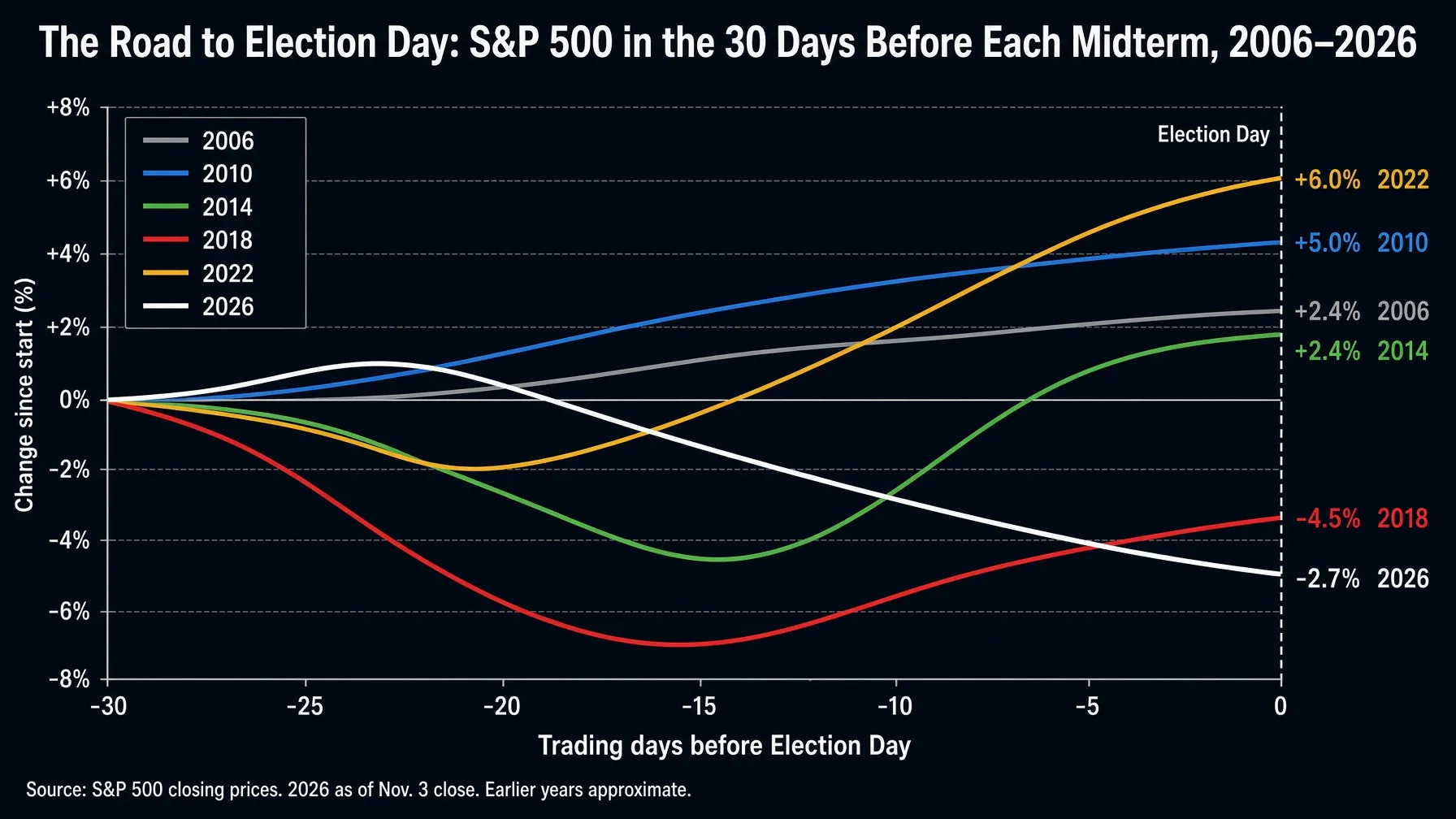
Optimists have a powerful statistic on their side. The S&P 500 has been higher one year after all 19 midterm elections since 1950, gaining about 16.6% on average. Weakness into midterms is the norm: BTIG’s Jonathan Krinsky found the index typically suffers a 14% drawdown at some point in the second half of midterm years, and the rebound often starts right after the vote.
Morgan Stanley’s Mike Wilson expects any post-election selloff to be short-lived. Options traders agree, pricing Wednesday as only about 20% more volatile than a normal day.
But the pattern is a tendency, not a guarantee. The S&P 500 is still up roughly 12% this year, so the cushion that usually fuels a post-midterm rally is thinner than in years that bottomed deep in the red. As one strategist told The National, clearing the election helps sentiment “but it does not create earnings growth.” If AI profits keep disappointing, history alone will not rescue portfolios.
What to watch next
The next 36 hours will show whether the Massacre was a buying opportunity or the start of something worse.
- Tonight: AMD earnings after the bell, then the first House and Senate calls.
- Wednesday open: whether AI and chip stocks extend their slide on a clear result, or rally once uncertainty clears.
- Bonds and the dollar: a sharp move in Treasury yields would signal markets repricing federal spending and borrowing.
- Support levels: whether the S&P 500 can reclaim the technical floor it lost last week.
The midterms will end tonight. The questions about AI profits that started this selloff will not.